Resume-tailoring guide
Tailor your resume in 10 minutes—without rewriting your life story.
The point of tailoring is not a full rewrite. It is to put your most relevant, supportable evidence where this employer is likely to look first.
Start here
Use what is true. Make it easy to see.
The point of tailoring is not a full rewrite. It is to put your most relevant, supportable evidence where this employer is likely to look first.
Use the employer's words when they are true for your experience—not as a substitute for it.
A five-step guide
Small, focused changes are easier to test.
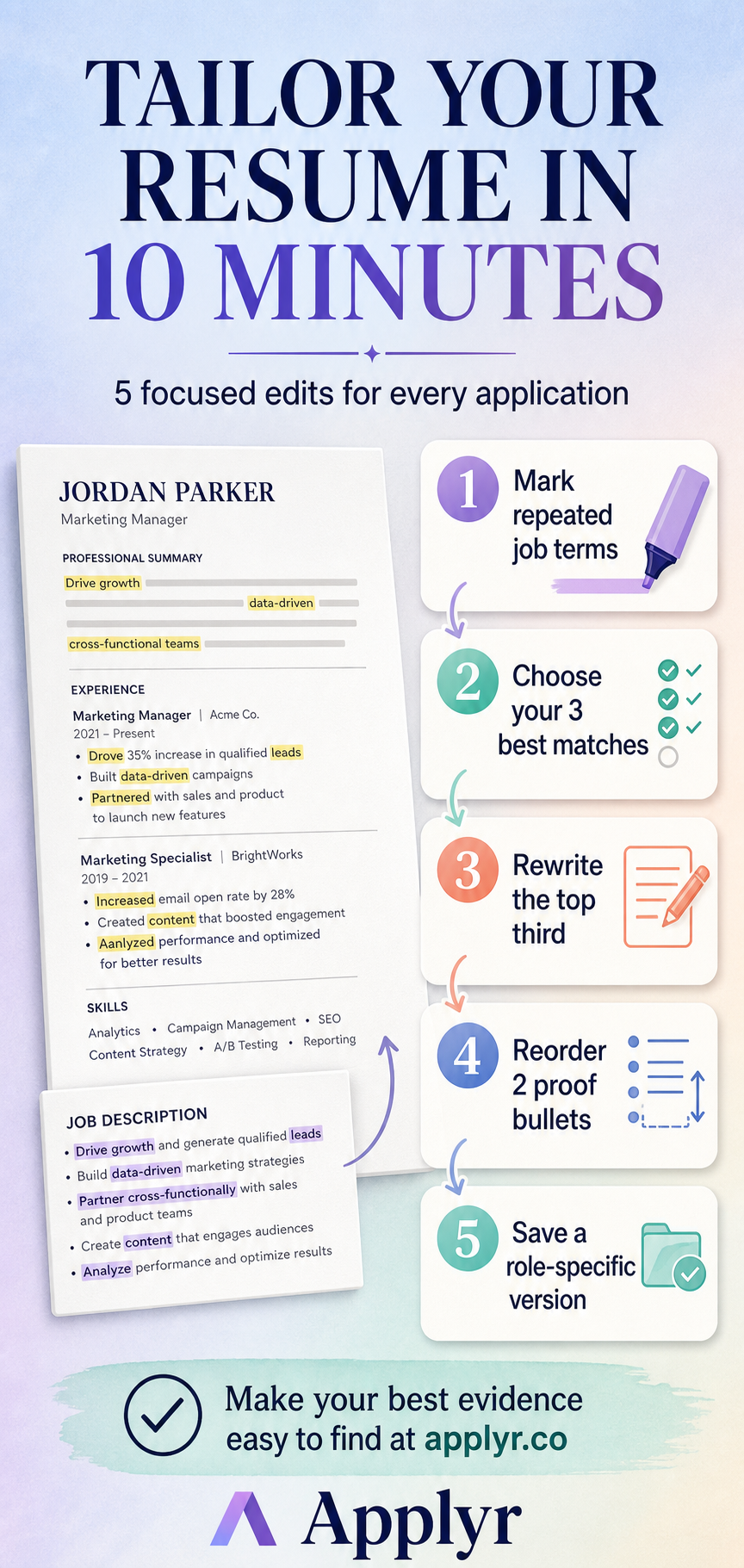
Read for repeated terms
Mark the role title, core skills, tools, and recurring responsibilities in the job description.
Choose your three best matches
Find the experience, project, or result that most clearly supports each of the role's central needs.
Rewrite the top third
Update the headline, summary, and skills order so the target role is obvious immediately.
Reorder two evidence bullets
Move the proof most relevant to the role higher in your recent experience.
Save a role-specific version
Name the file clearly, review the final PDF, and keep a record of the version you submitted.
Clarity check
Translate truthfully; do not copy blindly.
A generic bullet
“Supported new customers and resolved issues.”
A tailored, truthful bullet
“Supported new customers through product setup and resolved early adoption issues.”
Review before you send
Keep the tailoring focused and honest.
| What you notice | What to do next |
|---|---|
| The job uses a term you have not used | Check whether your equivalent experience is real, then describe the overlap precisely. |
| The resume is becoming too long | Reorder and refine existing evidence before adding more content. |
| You are changing every line | Return to the three core needs. Targeted edits are usually more useful than a wholesale rewrite. |