Job-search reset guide
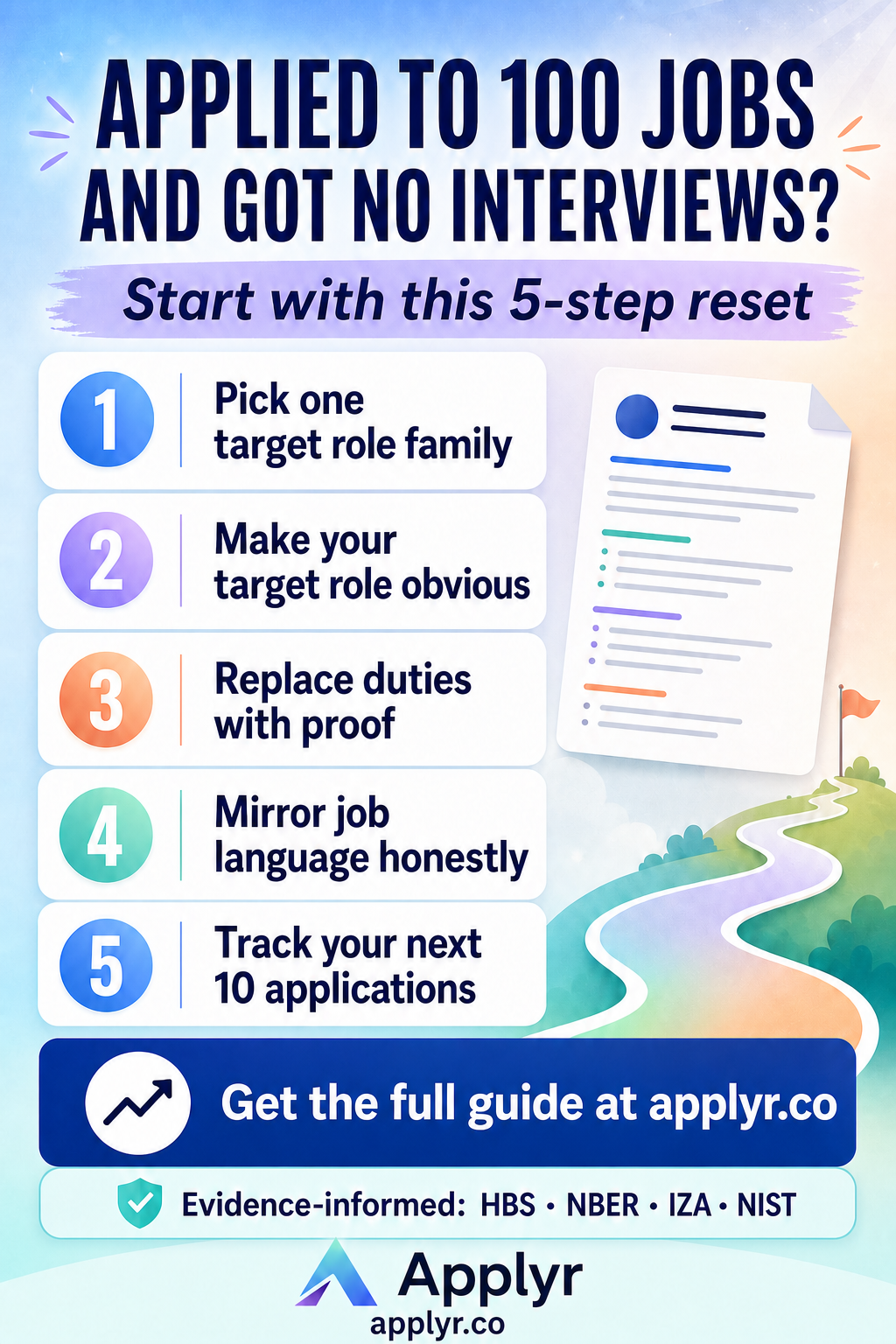
Applied to 100 jobs and got no interviews? Start with the next 10.
Silence is information, not a verdict on your ability. The next 10 applications should help you identify whether the problem is role clarity, evidence, relevance, or targeting.
Start here
Use what is true. Make it easy to see.
Silence is information, not a verdict on your ability. The next 10 applications should help you identify whether the problem is role clarity, evidence, relevance, or targeting.
This is a clarity check, not a promise of an interview or offer.
A five-step guide
Small, focused changes are easier to test.
Pick one target role family
Choose related roles that use the same core skills. A focused set gives you feedback you can use.
Make your target role obvious
Put the role family, relevant domain, and one truthful piece of proof near the top of page one.
Replace duties with proof
Use action + task + result. Name the scale, improvement, or outcome when you can support it.
Mirror job language honestly
Use the employer's terms only where they describe work you have truly done.
Track your next 10 applications
Record the role, resume version, date, and outcome. Change one variable at a time.
Clarity check
Help the reader see the work you actually did.
A duty alone
“Managed executive calendars.” It may be true, but it does not show scope or what improved.
A truthful proof point
“Coordinated schedules for five executives and introduced a weekly planning system that reduced conflicts.”
Review before you send
Review the pattern before changing everything.
| What you notice | What to do next |
|---|---|
| No replies across similar, well-matched roles | Review targeting, role clarity, evidence, and tailoring. |
| Replies only for a different role | Review the role your resume is currently signalling. |
| Recruiter screens but no interviews | Review how you explain fit, availability, compensation, or your career narrative. |
| Interviews but no offers | Review interview preparation and follow-up—not a resume rewrite. |