Career-break guide
A career break needs context, not an apology.
A gap can make a reader pause. A short, truthful explanation and current evidence help them understand the story without asking them to guess.
Start here
Use what is true. Make it easy to see.
A gap can make a reader pause. A short, truthful explanation and current evidence help them understand the story without asking them to guess.
You do not need to disclose private details to explain a break clearly.
A five-step guide
Small, focused changes are easier to test.
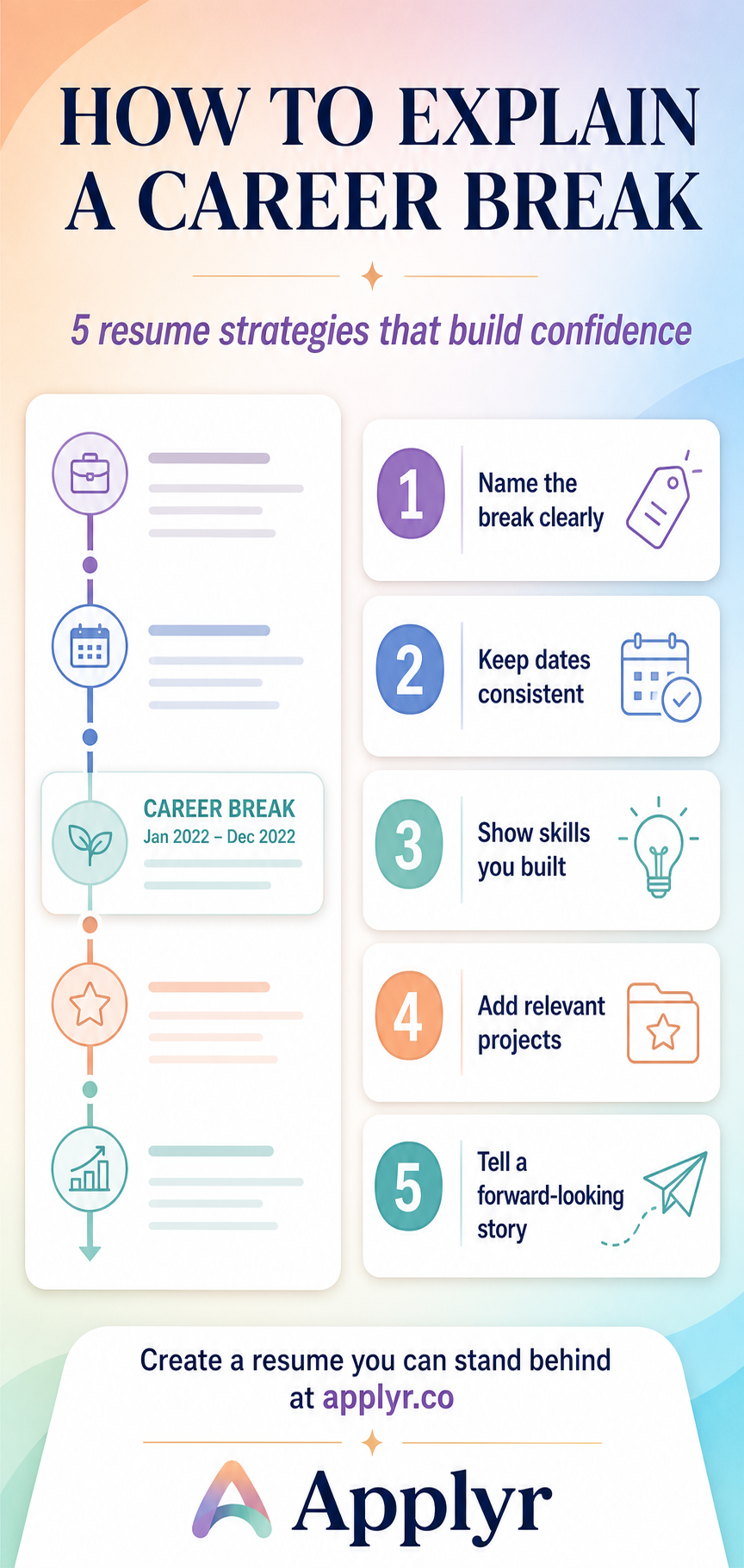
Name the break clearly
Use a brief phrase such as career break, caregiving, study, relocation, or independent work when it is accurate.
Keep dates consistent
Make your resume and LinkedIn agree on employment dates and major transitions.
Show skills you built
Include current courses, certifications, projects, contract work, or volunteer activity only when it is relevant.
Add relevant projects
Use a focused project to demonstrate readiness for the role you want now.
Tell a forward-looking story
Keep the explanation brief, then move attention to the value you are ready to bring.
Clarity check
Clarity gives the reader a better place to start.
An unexplained blank
A missing period that leaves the reader to infer what happened.
A concise context line
“Career break — caregiving; completed a current Excel course and supported a local nonprofit’s event planning.”
Review before you send
Keep the story consistent across your application.
| What you notice | What to do next |
|---|---|
| Your dates do not match across profiles | Correct the dates before you apply so a reviewer does not have to resolve the conflict. |
| The break dominates the page | Use one concise line, then prioritize current skills and the role you are targeting. |
| You changed career direction | Make transferable proof and relevant current learning easy to find. |